Lucien’s Forged Bills of Exchange
Illusions perduesLucien’s Forged Bills of Exchange turn financial desperation into a concrete betrayal: Lucien de Rubempré uses David Séchard’s name to obtain money, pays debts of his own and Coralie’s, and leaves David to face the consequences when the bills fall due. The three instruments, each for 1,000 francs, connect Lucien’s precarious literary life to the commercial machinery of discounting, protest, and debt enforcement. Their effects reach beyond a private deception, helping bring the Séchard family into crisis and forcing Lucien to confront the harm he has done.
Making and Discounting the Bills
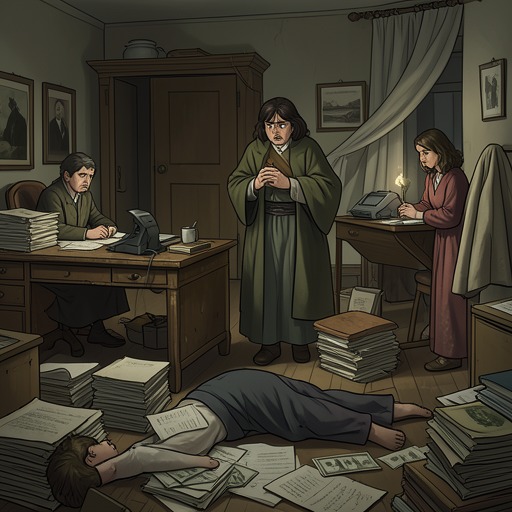
When money presses on him, Lucien makes three bills for 1,000 francs each, payable at one, two, and three months. He reproduces David’s signature with remarkable precision and endorses the instruments. The next day, he takes them to Métivier, a paper merchant on Rue Serpente, who discounts them without difficulty. In this transaction, David’s trusted name becomes the means by which Lucien secures immediate funds.
Lucien writes to his brother-in-law to disclose the forgery, explaining that he could not wait for the post and promising to provide the money when the bills mature. The letter makes the deception explicit but does not prevent it: Lucien has already put the documents into circulation, and repayment depends on funds he has yet to secure. The promise therefore marks both an attempt at disclosure and the precariousness of the plan.
What the Money Pays For
The proceeds clear debts owed by Lucien and Coralie. Afterward, 300 francs remain; Lucien gives them to Bérénice and tells her not to hand him money even if he asks, because he fears being tempted to gamble. The bills thus do more than settle immediate obligations: they leave Lucien with a small reserve he is already trying to protect from his own possible recklessness.
The act belongs to a world in which artistic work and reputation are measured through commercial calculation. Dauriat describes publishing as speculation, distinguishes established authors from unknown writers, and cites the cost of paid reviews and the uncertain returns on books. Finot, in turn, describes buying into a weekly paper through an arrangement that gives him control while allowing another man to appear as its editor. Against this background, Lucien’s forged credit is another conversion of personal standing into money—but here the borrowed asset is not literary fame; it is David’s signature and the trust it carries.
Default and the Growing Account
A later account of return and expenses records one of the 1,000-franc effects, dated at Angoulême on February 10, 1822. It had been subscribed by Séchard Fils to Lucien Chardon, also identified as De Rubembré, then passed to Métivier and onward. Due on April 30, it was protested by the bailiff Victor-Ange-Herménégilde Doublon on May 1. The account, dated May 2, shows how an unpaid principal grows through the formal costs of collection: protest, commission, brokerage, stamp, interest, and letter charges bring the sum to 1,037.45 francs, with an additional charge for exchange stated in the calculation.
The document’s exact figures make the injury legible as arithmetic. A 1,000-franc bill is no longer simply a sum Lucien borrowed against a promise to repay; it has become a claim advanced through merchants and enforced through legal procedure. The charges attach themselves to David’s obligation, so that delay and collection increase the burden beyond the original face value.
Consequences for David and Lucien
When Lucien returns to the family’s affairs, he learns from a doctor that David is believed to be in prison over drafts from Paris and that David’s father refused to help him. Lucien asks why David has been imprisoned, then recognizes the bills as his own work. Alone with the priest, he admits that he made the instruments David could not pay and says that he has ruined him. He had assumed that a wealthy intermediary had settled the claims after the earlier pursuit of the bills subsided; now he understands that the danger remains.
David’s vulnerability is sharpened by the earlier conflict with his father over the printing business. David is gentle, recoils from financial argument, and accepts onerous terms rather than pursue a costly, dishonoring suit over his mother’s fortune. That history does not excuse Lucien’s act; it clarifies how the forged credit falls on a man already burdened by a commercial arrangement with his own father. The bills expose the distance between Lucien’s promise to make funds available at maturity and the debt imposed on David when he cannot.
For Lucien, the discovery changes the meaning of his return: he no longer sees himself only as a man brought low by his own misfortunes, but as the cause of his sister’s and brother-in-law’s suffering. He asks the priest to go to Angoulême and learn the true state of affairs from Ève Séchard and Madame Chardon, hoping to discover whether the damage can still be remedied. The bills remain the material record of a choice whose consequences outlast the money they briefly supplied.